


Page 97 - 《橡塑技术与装备》英文版2026年3期
P. 97
TEST AND ANALYSIS


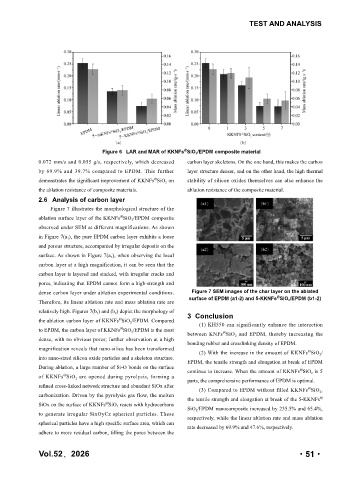
                                    Figure 6   LAR and MAR of KKNFs SiO 2 /EPDM composite material
                                                               @
              0.072 mm/s and 0.055 g/s, respectively, which decreased   carbon layer skeletons. On the one hand, this makes the carbon
              by 69.9% and 39.7% compared to EPDM. This further   layer structure denser, and on the other hand, the high thermal
              demonstrates the significant improvement of KKNFs SiO 2  on   stability of silicon oxides themselves can also enhance the
                                                     @
              the ablation resistance of composite materials.   ablation resistance of the composite material.
              2.6   Analysis of carbon layer
                  Figure 7 illustrates the morphological structure of the
                                          @
              ablation surface layer of the KKNFs SiO 2 /EPDM composite
              observed under SEM at different magnifications. As shown
              in Figure 7(a 1 ), the pure EPDM carbon layer exhibits a loose
              and porous structure, accompanied by irregular deposits on the
              surface. As shown in Figure 7(a 2 ), when observing the local
              carbon layer at a high magnification, it can be seen that the
              carbon layer is layered and stacked, with irregular cracks and
              pores, indicating that EPDM cannot form a high-strength and
              dense carbon layer under ablation experimental conditions.   Figure 7 SEM images of the char layer on the ablated
                                                                 surface of EPDM (a1-2) and 5-KKNFs SiO 2 /EPDM (b1-2)
                                                                                              @
              Therefore, its linear ablation rate and mass ablation rate are
              relatively high. Figures 7(b 1 ) and (b 2 ) depict the morphology of   3  Conclusion
              the ablation carbon layer of KKNFs SiO 2 /EPDM. Compared
                                         @
                                                                    (1) KH550 can significantly enhance the interaction
                                          @
              to EPDM, the carbon layer of KKNFs SiO 2 /EPDM is the most
                                                                            @
                                                                between KNFs SiO 2  and EPDM, thereby increasing the
              dense, with no obvious pores; further observation at a high   bonding rubber and crosslinking density of EPDM.
              magnification reveals that nano-silica has been transformed
                                                                                                         @
                                                                    (2) With the increase in the amount of KKNFs SiO 2 /
              into nano-sized silicon oxide particles and a skeleton structure.
                                                                EPDM, the tensile strength and elongation at break of EPDM
              During ablation, a large number of Si-O bonds on the surface   continue to increase. When the amount of KKNFs SiO 2  is 5
                                                                                                      @
                      @
              of KKNFs SiO 2  are opened during pyrolysis, forming a   parts, the comprehensive performance of EPDM is optimal.
              refined cross-linked network structure and abundant SiOx after
                                                                                                         @
                                                                    (3) Compared to EPDM without filled KKNFs SiO 2 ,
              carbonization. Driven by the pyrolysis gas flow, the molten
                                                                the tensile strength and elongation at break of the 5-KKNFs @
                                     @
              SiOx on the surface of KKNFs SiO 2  reacts with hydrocarbons   SiO 2 /EPDM nanocomposite increased by 235.5% and 65.4%,
              to generate irregular SixOyCz spherical particles. These
                                                                respectively, while the linear ablation rate and mass ablation
              spherical particles have a high specific surface area, which can
                                                                rate decreased by 69.9% and 47.6%, respectively.
              adhere to more residual carbon, filling the pores between the
              Vol.52,2026                                                                            ·51·

