


Page 95 - 《橡塑技术与装备》英文版2026年3期
P. 95
TEST AND ANALYSIS


                                                                        @
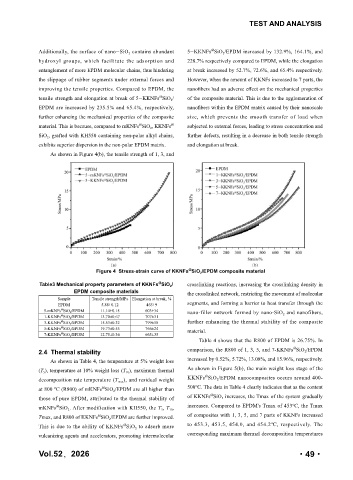
              Additionally, the surface of nano-SiO 2  contains abundant   5-KKNFs SiO 2 /EPDM increased by 132.9%, 164.1%, and
              hydroxyl groups, which facilitate the adsorption and   228.7% respectively compared to EPDM, while the elongation
              entanglement of more EPDM molecular chains, thus hindering   at break increased by 52.7%, 72.6%, and 65.4% respectively.
              the slippage of rubber segments under external forces and   However, when the amount of KKNFs increased to 7 parts, the
              improving the tensile properties. Compared to EPDM, the   nanofibers had an adverse effect on the mechanical properties
                                                       @
              tensile strength and elongation at break of 5-KKNFs SiO 2 /  of the composite material. This is due to the agglomeration of
              EPDM are increased by 235.5% and 65.4%, respectively,   nanofibers within the EPDM matrix caused by their nanoscale
              further enhancing the mechanical properties of the composite   size, which prevents the smooth transfer of load when
                                                @
              material. This is because, compared to mKNFs SiO 2 , KKNFs @  subjected to external forces, leading to stress concentration and
              SiO 2 , grafted with KH550 containing non-polar alkyl chains,   further defects, resulting in a decrease in both tensile strength
              exhibits superior dispersion in the non-polar EPDM matrix.  and elongation at break.
                  As shown in Figure 4(b), the tensile strength of 1, 3, and


                                 Figure 4  Stress-strain curve of KKNFs SiO 2 /EPDM composite material
                                                                 @
              Table3 Mechanical property parameters of KKNFs SiO 2 /  crosslinking reactions, increasing the crosslinking density in
                                                      @
                          EPDM composite materials              the crosslinked network, restricting the movement of molecular
                    Sample      Tensile strength/MPa Elongation at break, %
                     EPDM          5.88±0.12      463±9         segments, and forming a barrier to heat transfer through the
                      @
                5-mKNFs SiO 2 /EPDM  11.14±0.15   603±34        nano-filler network formed by nano-SiO 2  and nanofibers,
                      @
                1-KKNFs SiO 2 /EPDM  13.70±0.67   707±31
                      @
                3-KKNFs SiO 2 /EPDM  15.53±0.32   799±58        further enhancing the thermal stability of the composite
                      @
                5-KKNFs SiO 2 /EPDM  19.73±0.55   766±24        material.
                7-KKNFs SiO 2 /EPDM  12.75±0.36   665±35
                      @
                                                                    Table 4 shows that the R800 of EPDM is 26.75%. In
                                                                                                    @
              2.4  Thermal stability                            comparison, the R800 of 1, 3, 5, and 7-KKNFs SiO 2 /EPDM
                  As shown in Table 4, the temperature at 5% weight loss   increased by 0.52%, 5.72%, 13.08%, and 15.96%, respectively.
              (T 5 ), temperature at 10% weight loss (T 10 ), maximum thermal   As shown in Figure 5(b), the main weight loss stage of the
                                                                      @
              decomposition rate temperature (T max ), and residual weight   KKNFs SiO 2 /EPDM nanocomposites occurs around 400-
              at 800 ºC (R800) of mKNFs SiO 2 /EPDM are all higher than   500℃. The data in Table 4 clearly indicates that as the content
                                   @
                                                                        @
              those of pure EPDM, attributed to the thermal stability of   of KKNFs SiO 2  increases, the Tmax of the system gradually
                    @
              mKNFs SiO 2 . After modification with KH550, the T 5 , T 10 ,   increases. Compared to EPDM's Tmax of 453℃, the Tmax
                                  @
              Tmax, and R800 of KKNFs SiO 2 /EPDM are further improved.   of composites with 1, 3, 5, and 7 parts of KKNFs increased
                                           @
              This is due to the ability of KKNFs SiO 2  to adsorb more   to 453.3, 453.5, 454.0, and 454.2℃, respectively. The
              vulcanizing agents and accelerators, promoting intermolecular   corresponding maximum thermal decomposition temperatures
              Vol.52,2026                                                                            ·49·

