


Page 94 - 《橡塑技术与装备》英文版2026年3期
P. 94
HINA R&P  TECHNOLOGY  AND EQUIPMENT


            Table 2 Thermal decomposition data of KNFs, mKNFs @  of EPDM is 2.01×10⁻⁴ mol/cm3. Compared to EPDM, the
                                       @
                                                                                       @
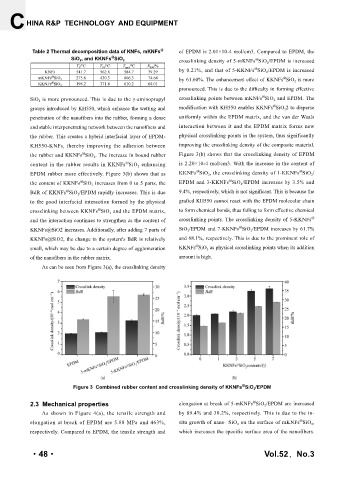
                         SiO 2 , and KKNFs SiO 2             crosslinking density of 5-mKNFs SiO 2 /EPDM is increased
                           T 5 /℃  T 10 /℃  T max /℃  R 800 /%                         @
                KNFs       541.7   562.8   584.7   39.29     by 0.21%, and that of 5-KKNFs SiO 2 /EPDM is increased
                  @
                                                                                                 @
              mKNFs SiO 2  275.8   430.3   606.3   74.64     by 61.60%. The enhancement effect of KKNFs SiO 2  is more
                  @
              KKNFs SiO 2  198.2   371.8   610.2   64.01
                                                             pronounced. This is due to the difficulty in forming effective
                                                                                         @
           SiO 2  is more pronounced. This is due to the γ-aminopropyl   crosslinking points between mKNFs SiO 2  and EPDM. The
                                                                                             @
           groups introduced by KH550, which enhance the wetting and   modification with KH550 enables KKNFs SiO 2 2 to disperse
           penetration of the nanofibers into the rubber, forming a dense   uniformly within the EPDM matrix, and the van der Waals
           and stable interpenetrating network between the nanofibers and   interaction between it and the EPDM matrix forms new
           the rubber. This creates a hybrid interfacial layer of EPDM-  physical crosslinking points in the system, thus significantly
           KH550-KNFs, thereby improving the adhesion between   improving the crosslinking density of the composite material.
                             @
           the rubber and KKNFs SiO 2 . The increase in bound rubber   Figure 3(b) shows that the crosslinking density of EPDM
           content in the rubber results in KKNFs SiO 2  enhancing   is 2.20×10⁻⁴ mol/cm3. With the increase in the content of
                                           @
                                                                   @
                                                                                                      @
           EPDM rubber more effectively. Figure 3(b) shows that as   KKNFs SiO 2 , the crosslinking density of 1-KKNFs SiO 2 /
                                                                              @
                            @
           the content of KKNFs SiO 2  increases from 0 to 5 parts, the   EPDM and 3-KKNFs SiO 2 /EPDM increases by 3.5% and
           BdR of KKNFs SiO 2 /EPDM rapidly increases. This is due   9.4%, respectively, which is not significant. This is because the
                       @
           to the good interfacial interaction formed by the physical   grafted KH550 cannot react with the EPDM molecular chain
                                  @
           crosslinking between KKNFs SiO 2  and the EPDM matrix,   to form chemical bonds, thus failing to form effective chemical
           and the interaction continues to strengthen as the content of   crosslinking points. The crosslinking density of 5-KKNFs @
                                                                                  @
           KKNFs@SiO2 increases. Additionally, after adding 7 parts of   SiO 2 /EPDM and 7-KKNFs SiO 2 /EPDM increases by 61.7%
           KKNFs@SiO2, the change in the system's BdR is relatively   and 68.1%, respectively. This is due to the prominent role of
                                                                   @
           small, which may be due to a certain degree of agglomeration   KKNFs SiO 2  as physical crosslinking points when its addition
           of the nanofibers in the rubber matrix.           amount is high.
               As can be seen from Figure 3(a), the crosslinking density


                          Figure 3  Combined rubber content and crosslinking density of KKNFs SiO 2 /EPDM
                                                                                   @
                                                                                      @
           2.3  Mechanical properties                        elongation at break of 5-mKNFs SiO 2 /EPDM are increased
               As shown in Figure 4(a), the tensile strength and   by 89.4% and 30.2%, respectively. This is due to the in-
           elongation at break of EPDM are 5.88 MPa and 463%,   situ growth of nano-SiO 2  on the surface of mKNFs SiO 2 ,
                                                                                                      @
           respectively. Compared to EPDM, the tensile strength and   which increases the specific surface area of the nanofibers.


           ·48·                                                                           Vol.52,No.3

