


Page 93 - 《橡塑技术与装备》英文版2026年3期
P. 93
TEST AND ANALYSIS


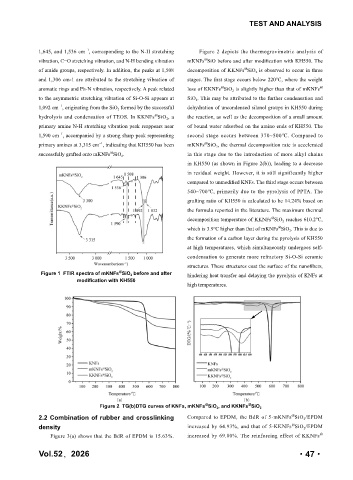
              1,645, and 1,536 cm , corresponding to the N-H stretching   Figure 2 depicts the thermogravimetric analysis of
                              -1
              vibration, C=O stretching vibration, and N-H bending vibration   mKNFs SiO before and after modification with KH550. The
                                                                      @
                                                                                   @
              of amide groups, respectively. In addition, the peaks at 1,508   decomposition of KKNFs SiO 2  is observed to occur in three
              and 1,306 cm-1 are attributed to the stretching vibration of   stages. The first stage occurs below 220℃, where the weight
                                                                            @
              aromatic rings and Ph-N vibration, respectively. A peak related   loss of KKNFs SiO 2  is slightly higher than that of mKNFs @
              to the asymmetric stretching vibration of Si-O-Si appears at   SiO 2 . This may be attributed to the further condensation and
                     -1
              1,092 cm , originating from the SiO 2  formed by the successful   dehydration of uncondensed silanol groups in KH550 during
              hydrolysis and condensation of TEOS. In KKNFs SiO 2 , a   the reaction, as well as the decomposition of a small amount
                                                     @
              primary amine N-H stretching vibration peak reappears near   of bound water adsorbed on the amino ends of KH550. The
                     -1
              1,590 cm , accompanied by a strong sharp peak representing   second stage occurs between 370~500℃. Compared to
              primary amines at 3,315 cm , indicating that KH550 has been   mKNFs SiO 2 , the thermal decomposition rate is accelerated
                                  -1
                                                                      @
                                      @
              successfully grafted onto mKNFs SiO 2 .           in this stage due to the introduction of more alkyl chains
                                                                in KH550 (as shown in Figure 2(b)), leading to a decrease
                                                                in residual weight. However, it is still significantly higher
                                                                compared to unmodified KNFs. The third stage occurs between
                                                                540~700℃, primarily due to the pyrolysis of PPTA. The
                                                                grafting ratio of KH550 is calculated to be 14.24% based on
                                                                the formula reported in the literature. The maximum thermal
                                                                decomposition temperature of KKNFs SiO 2  reaches 610.2℃,
                                                                                             @
                                                                                               @
                                                                which is 3.9℃ higher than that of mKNFs SiO 2 . This is due to
                                                                the formation of a carbon layer during the pyrolysis of KH550
                                                                at high temperatures, which simultaneously undergoes self-
                                                                condensation to generate more refractory Si-O-Si ceramic
                                                                structures. These structures coat the surface of the nanofibers,
                                         @
               Figure 1  FTIR spectra of mKNFs SiO 2  before and after   hindering heat transfer and delaying the pyrolysis of KNFs at
                           modification with KH550
                                                                high temperatures.


                                                                      @              @
                                   Figure 2  TG(b)DTG curves of KNFs, mKNFs SiO 2 , and KKNFs SiO 2
              2.2 Combination of rubber and crosslinking        Compared to EPDM, the BdR of 5-mKNFs SiO 2 /EPDM
                                                                                                   @
                                                                                                   @
              density                                           increased by 64.93%, and that of 5-KKNFs SiO 2 /EPDM
                  Figure 3(a) shows that the BdR of EPDM is 15.63%.   increased by 69.80%. The reinforcing effect of KKNFs @

              Vol.52,2026                                                                            ·47·

