


Page 102 - 《橡塑技术与装备》英文版2026年3期
P. 102
HINA R&P  TECHNOLOGY  AND EQUIPMENT


                                                             turbine-traction dual-axis orientation stretching device involves
                                                             first cooling the extruded tube blank to room temperature
                                                             and then heating it to the stretching temperature. Specifically,
                                                             when the tube blank is pulled into the heating device by the
                                                             first traction machine for secondary heating, it is heated to a
                                                             highly elastic state, and then undergoes bidirectional stretching
           Figure 5  Overall structural diagram of shunt and bracket design  through an online production process using a movable

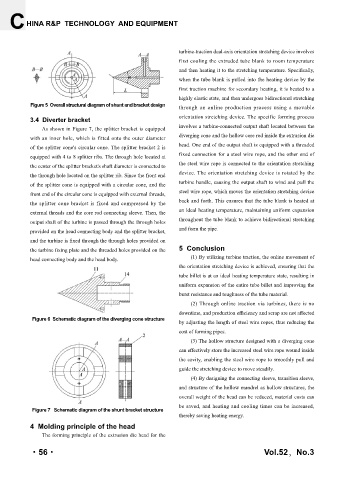
           3.4  Diverter bracket                             orientation stretching device. The specific forming process
               As shown in Figure 7, the splitter bracket is equipped   involves a turbine-connected output shaft located between the
           with an inner hole, which is fitted onto the outer diameter   diverging cone and the hollow core rod inside the extrusion die
           of the splitter cone's circular cone. The splitter bracket 2 is   head. One end of the output shaft is equipped with a threaded
           equipped with 4 to 8 splitter ribs. The through hole located at   fixed connection for a steel wire rope, and the other end of
           the center of the splitter bracket's shaft diameter is connected to   the steel wire rope is connected to the orientation stretching
           the through hole located on the splitter rib. Since the front end   device. The orientation stretching device is rotated by the
                                                             turbine handle, causing the output shaft to wind and pull the
           of the splitter cone is equipped with a circular cone, and the
           front end of the circular cone is equipped with external threads,   steel wire rope, which moves the orientation stretching device
           the splitter cone bracket is fixed and compressed by the   back and forth. This ensures that the tube blank is heated at
           external threads and the core rod connecting sleeve. Then, the   an ideal heating temperature, maintaining uniform expansion
           output shaft of the turbine is passed through the through holes   throughout the tube blank to achieve bidirectional stretching
           provided on the head connecting body and the splitter bracket,   and form the pipe.
           and the turbine is fixed through the through holes provided on
           the turbine fixing plate and the threaded holes provided on the   5  Conclusion
           head connecting body and the head body.               (1) By utilizing turbine traction, the online movement of
                                                             the orientation stretching device is achieved, ensuring that the
                                                             tube billet is at an ideal heating temperature state, resulting in
                                                             uniform expansion of the entire tube billet and improving the

                                                             burst resistance and toughness of the tube material.
                                                                 (2) Through online traction via turbines, there is no
                                                             downtime, and production efficiency and scrap are not affected
            Figure 6  Schematic diagram of the diverging cone structure
                                                             by adjusting the length of steel wire ropes, thus reducing the
                                                             cost of forming pipes.
                                                                 (3) The hollow structure designed with a diverging cone
                                                             can effectively store the increased steel wire rope wound inside
                                                             the cavity, enabling the steel wire rope to smoothly pull and
                                                             guide the stretching device to move steadily.
                                                                 (4) By designing the connecting sleeve, transition sleeve,
                                                             and structure of the hollow mandrel as hollow structures, the
                                                             overall weight of the head can be reduced, material costs can
                                                             be saved, and heating and cooling times can be increased,
            Figure 7   Schematic diagram of the shunt bracket structure
                                                             thereby saving heating energy.
           4  Molding principle of the head
               The forming principle of the extrusion die head for the

           ·56·                                                                           Vol.52,No.3

