


Page 70 - 《橡塑技术与装备》英文版2026年3期
P. 70
HINA R&P  TECHNOLOGY  AND EQUIPMENT


           2.2  Site selection                               communication terminals with 5G terminals, the interference
               5G core network servers and base station BBUs are   and packet loss issues inherent in traditional wireless networks
           generally placed in the existing communication equipment   are resolved. This enables AGV forklifts and stacking robots to
           rooms of the factory, sharing resources such as mains power   achieve faster and more reliable responses, facilitating logistics
           and cabinets with the original equipment in the room. If a   connectivity between the three-dimensional warehouse and
           high-power RRU solution is adopted, high-power RRU and   various processes and production lines. The 5G industrial
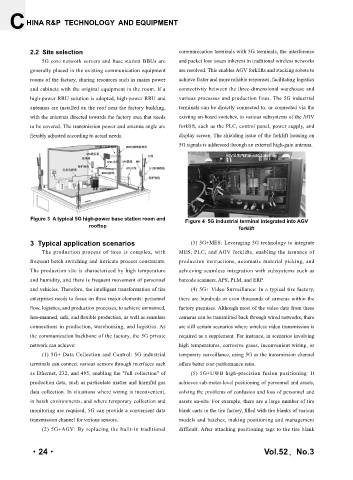
           antennas are installed on the roof near the factory building,   terminals can be directly connected to, or connected via the
           with the antennas directed towards the factory area that needs   existing on-board switches, to various subsystems of the AGV
           to be covered. The transmission power and antenna angle are   forklift, such as the PLC, control panel, power supply, and
           flexibly adjusted according to actual needs.      display screen. The shielding issue of the forklift housing on
                                                             5G signals is addressed through an external high-gain antenna.


           Figure 3  A typical 5G high-power base station room and   Figure 4  5G industrial terminal integrated into AGV
                               rooftop                                            forklift

           3  Typical application scenarios                      (3) 5G+MES: Leveraging 5G technology to integrate
               The  production  process  of  tires  is  complex,  with   MES, PLC, and AGV forklifts, enabling the issuance of
           frequent batch switching and intricate process constraints.   production instructions, automatic material picking, and
           The production site is characterized by high temperature   achieving seamless integration with subsystems such as
           and humidity, and there is frequent movement of personnel   barcode scanners, APS, PLM, and ERP.
           and vehicles. Therefore, the intelligent transformation of tire   (4) 5G+ Video Surveillance: In a typical tire factory,
           enterprises needs to focus on three major elements: personnel   there are hundreds or even thousands of cameras within the
           flow, logistics, and production processes, to achieve unmanned,   factory premises. Although most of the video data from these
           less-manned, safe, and flexible production, as well as seamless   cameras can be transmitted back through wired networks, there
           connections in production, warehousing, and logistics. As   are still certain scenarios where wireless video transmission is
           the communication backbone of the factory, the 5G private   required as a supplement. For instance, in scenarios involving
           network can achieve:                              high temperatures, corrosive gases, inconvenient wiring, or
               (1) 5G+ Data Collection and Control: 5G industrial   temporary surveillance, using 5G as the transmission channel
           terminals can connect various sensors through interfaces such   offers better cost-performance ratio.
           as Ethernet, 232, and 485, enabling the "full collection" of   (5) 5G+UWB high-precision fusion positioning: It
           production data, such as particulate matter and harmful gas   achieves sub-meter-level positioning of personnel and assets,
           data collection. In situations where wiring is inconvenient,   solving the problems of confusion and loss of personnel and
           in harsh environments, and where temporary collection and   assets on-site. For example, there are a large number of tire
           monitoring are required, 5G can provide a convenient data   blank carts in the tire factory, filled with tire blanks of various
           transmission channel for various sensors.         models and batches, making positioning and management
               (2) 5G+AGV: By replacing the built-in traditional   difficult. After attaching positioning tags to the tire blank


           ·24·                                                                           Vol.52,No.3

