


Page 66 - 《橡塑技术与装备》英文版2026年3期
P. 66
HINA R&P  TECHNOLOGY  AND EQUIPMENT


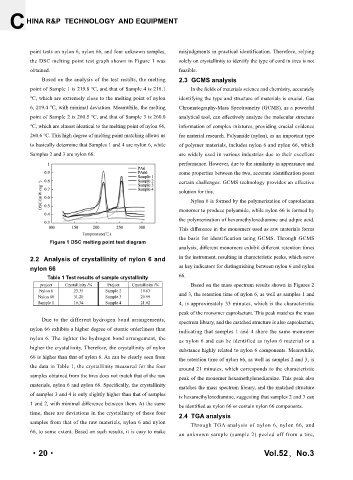
           point tests on nylon 6, nylon 66, and four unknown samples,   misjudgments in practical identification. Therefore, relying
           the DSC melting point test graph shown in Figure 1 was   solely on crystallinity to identify the type of cord in tires is not
           obtained.                                         feasible.
               Based on the analysis of the test results, the melting   2.3  GCMS analysis
           point of Sample 1 is 219.8 ℃, and that of Sample 4 is 218.1   In the fields of materials science and chemistry, accurately
           ℃, which are extremely close to the melting point of nylon   identifying the type and structure of materials is crucial. Gas
           6, 219.4 ℃, with minimal deviation. Meanwhile, the melting   Chromatography-Mass Spectrometry (GCMS), as a powerful
           point of Sample 2 is 260.5 ℃, and that of Sample 3 is 260.0   analytical tool, can effectively analyze the molecular structure
           ℃, which are almost identical to the melting point of nylon 66,   information of complex mixtures, providing crucial evidence
           260.6 ℃. This high degree of melting point matching allows us   for material research. Polyamide (nylon), as an important type
           to basically determine that Samples 1 and 4 are nylon 6, while   of polymer materials, includes nylon 6 and nylon 66, which
           Samples 2 and 3 are nylon 66.                     are widely used in various industries due to their excellent
                                                             performance. However, due to the similarity in appearance and
                                                             some properties between the two, accurate identification poses
                                                             certain challenges. GCMS technology provides an effective
                                                             solution for this.
                                                                 Nylon 6 is formed by the polymerization of caprolactam
                                                             monomer to produce polyamide, while nylon 66 is formed by
                                                             the polymerization of hexamethylenediamine and adipic acid.
                                                             This difference in the monomers used as raw materials forms
                                                             the basis for identification using GCMS. Through GCMS
                  Figure 1 DSC melting point test diagram
                                                             analysis, different monomers exhibit different retention times

           2.2  Analysis of crystallinity of nylon 6 and     in the instrument, resulting in characteristic peaks, which serve
           nylon 66                                          as key indicators for distinguishing between nylon 6 and nylon
                 Table 1 Test results of sample crystallinity  66.
               project  Crystallinity /%  Project  Crystallinity /%  Based on the mass spectrum results shown in Figures 2
              Nylon 6     23.35      Sample 2   19.63
              Nylon 66    31.20      Sample 3   20.99        and 3, the retention time of nylon 6, as well as samples 1 and
              Sample 1    16.34      Sample 4   21.62        4, is approximately 33 minutes, which is the characteristic
                                                             peak of the monomer caprolactam. This peak matches the mass
               Due to the different hydrogen bond arrangements,   spectrum library, and the matched structure is also caprolactam,
           nylon 66 exhibits a higher degree of atomic orderliness than   indicating that samples 1 and 4 share the same monomer
           nylon 6. The tighter the hydrogen bond arrangement, the   as nylon 6 and can be identified as nylon 6 material or a
           higher the crystallinity. Therefore, the crystallinity of nylon   substance highly related to nylon 6 components. Meanwhile,
           66 is higher than that of nylon 6. As can be clearly seen from   the retention time of nylon 66, as well as samples 2 and 3, is
           the data in Table 1, the crystallinity measured for the four   around 21 minutes, which corresponds to the characteristic
           samples obtained from the tires does not match that of the raw   peak of the monomer hexamethylenediamine. This peak also
           materials, nylon 6 and nylon 66. Specifically, the crystallinity   matches the mass spectrum library, and the matched structure
           of samples 3 and 4 is only slightly higher than that of samples   is hexamethylenediamine, suggesting that samples 2 and 3 can
           1 and 2, with minimal difference between them. At the same   be identified as nylon 66 or contain nylon 66 components.
           time, there are deviations in the crystallinity of these four   2.4  TGA analysis
           samples from that of the raw materials, nylon 6 and nylon   Through TGA analysis of nylon 6, nylon 66, and
           66, to some extent. Based on such results, it is easy to make
                                                             an unknown sample (sample 2) peeled off from a tire,

           ·20·                                                                           Vol.52,No.3

