


Page 72 - 《橡塑技术与装备》英文版2026年3期
P. 72
HINA R&P  TECHNOLOGY  AND EQUIPMENT


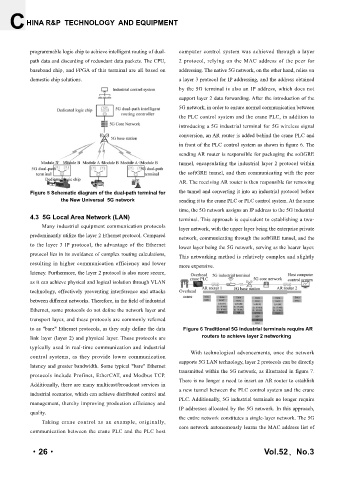
           programmable logic chip to achieve intelligent routing of dual-  computer control system was achieved through a layer
           path data and discarding of redundant data packets. The CPU,   2 protocol, relying on the MAC address of the peer for
           baseband chip, and FPGA of this terminal are all based on   addressing. The native 5G network, on the other hand, relies on
           domestic chip solutions.                          a layer 3 protocol for IP addressing, and the address obtained
                                                             by the 5G terminal is also an IP address, which does not
                                                             support layer 2 data forwarding. After the introduction of the
                                                             5G network, in order to ensure normal communication between
                                                             the PLC control system and the crane PLC, in addition to
                                                             introducing a 5G industrial terminal for 5G wireless signal
                                                             conversion, an AR router is added behind the crane PLC and
                                                             in front of the PLC control system as shown in figure 6. The
                                                             sending AR router is responsible for packaging the softGRE
                                                             tunnel, encapsulating the industrial layer 2 protocol within
                                                             the softGRE tunnel, and then communicating with the peer
                                                             AR. The receiving AR router is then responsible for removing
           Figure 5 Schematic diagram of the dual-path terminal for   the tunnel and converting it into an industrial protocol before
                      the New Universal  5G network          sending it to the crane PLC or PLC control system. At the same
                                                             time, the 5G network assigns an IP address to the 5G industrial
           4.3  5G Local Area Network (LAN)                  terminal. This approach is equivalent to establishing a two-
               Many industrial equipment communication protocols   layer network, with the upper layer being the enterprise private
           predominantly utilize the layer 2 Ethernet protocol. Compared   network, communicating through the softGRE tunnel, and the
           to the layer 3 IP protocol, the advantage of the Ethernet   lower layer being the 5G network, serving as the bearer layer.
           protocol lies in its avoidance of complex routing calculations,   This networking method is relatively complex and slightly
           resulting in higher communication efficiency and lower   more expensive.
           latency. Furthermore, the layer 2 protocol is also more secure,
           as it can achieve physical and logical isolation through VLAN
           technology, effectively preventing interference and attacks
           between different networks. Therefore, in the field of industrial
           Ethernet, some protocols do not define the network layer and
           transport layer, and these protocols are commonly referred
           to as "bare" Ethernet protocols, as they only define the data     Figure 6 Traditional 5G industrial terminals require AR
           link layer (layer 2) and physical layer. These protocols are   routers to achieve layer 2 networking
           typically used in real-time communication and industrial
                                                                 With technological advancements, once the network
           control systems, as they provide lower communication
                                                             supports 5G LAN technology, layer 2 protocols can be directly
           latency and greater bandwidth. Some typical "bare" Ethernet
           protocols include Profinet, EtherCAT, and Modbus TCP.   transmitted within the 5G network, as illustrated in figure 7.
                                                             There is no longer a need to insert an AR router to establish
           Additionally, there are many multicast/broadcast services in
                                                             a new tunnel between the PLC control system and the crane
           industrial scenarios, which can achieve distributed control and
           management, thereby improving production efficiency and   PLC. Additionally, 5G industrial terminals no longer require
                                                             IP addresses allocated by the 5G network. In this approach,
           quality.
                                                             the entire network constitutes a single-layer network. The 5G
               Taking  crane  control  as  an  example,  originally,
                                                             core network autonomously learns the MAC address list of
           communication between the crane PLC and the PLC host


           ·26·                                                                           Vol.52,No.3

