Page 85 - 《橡塑技术与装备》英文版2026年1月
P. 85

TEST AND ANALYSIS


                Table 3 Properties of the sample before and after aging,   Table 5 Properties of the sample before and after aging,
                            aging temperature 120  ℃                      with an aging temperature of 150   ℃
                                 1 #                2 #                             1 #               2 #
                Aging time /h  tensile   Elongation at   tensile   Elongation at   Aging time/ h  tensile   Elongation at   tensile   Elongation at
                          strength T b  break E b  strength T b  break E b  strength T b  break E b  strength T b  break E b
                    0        12      532      14.4      472           0        12       532      14.4     472
                   168      11.8     276       14       283           8       11.7      366      14.4     352
                   336      12.1     253      14.4      276           24      11.3      327      14.3     311
                   672      10.8     196      13.3      206           48      11.1      276      13.6     292
                   1008      10      162      13.1      192           72      10.8      246      13.3     246
                   2520      8.7     103      10.9      110          168       9.6      142      13.3     138
                   4032      8.4      23       9.4      63        2.4  Change in fractional strain energy after

                                                                  aging
                Table 4  Properties of the sample before and after aging,
                        with an aging temperature of 130   ℃          The loss of tensile strength and elongation can be
                             1 #      2 #      1 #      2 #       described by the fractional strain energy factor at fracture, as
                Aging time /h  tensile   Elongation at   tensile   Elongation at
                          strength T b  break E b  strength T b  break E b  expressed by Bergstrom (T E ) fO  (T E ) f  is defined as the ratio of the
                    0        12      532      14.4      472       product of the tensile strength after aging and the elongation at
                    24      12.4     326      14.3      336
                    72      11.4     271      14.4      303       fracture to that before aging. As shown in Equation
                   168       11      232      13.9      257
                   336      10.1     191      12.7      214                       =  (T × E b  ) before aging
                                                                                     b
                   672       9.6     141      11.7      152                        ( TE) f  (T × E  )                               (1)
                   1008      8.8      112     10.4      123                          b  b  after aging
                   1680      7        62       9.6      36
                                                                               1/ (TE ) − 1/ a  = k t '
                                                                                        '
                                                                                        
                                                                                   f
                                                                             ln k = − (E a  / RT +  ln A
                                                                                        )
                                                                                        '
                                                                               1/ (TE ) − 1/ a  =  k t '
                                                                                        
                                                                                   f
                                                                                '
                                                                                             A
                                                                             ln k = −( E ' a  / RT +  ln '
                                                                                         )
                                                                             ' t =   1/ (TE) ' f − 1/ a ÷  A '  exp −  E a '  / RT)
                                                                                                 (
                                                                                           


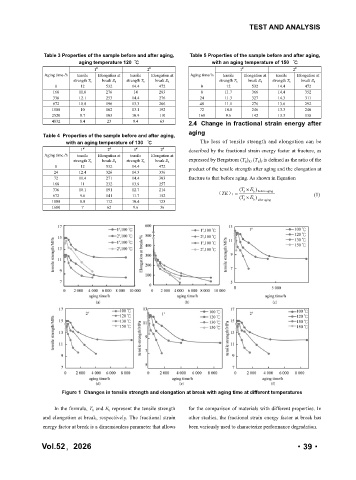
                      Figure 1  Changes in tensile strength and elongation at break with aging time at different temperatures

                    In the formula, T b  and E b  represent the tensile strength   for the comparison of materials with different properties. In
                and elongation at break, respectively. The fractional strain   other studies, the fractional strain energy factor at break has
                energy factor at break is a dimensionless parameter that allows   been variously used to characterize performance degradation.


               Vol.52,2026                                                                            ·39·
   80   81   82   83   84   85   86   87   88   89   90