


Page 90 - 《橡塑技术与装备》英文版2026年1月
P. 90
HINA R&P  TECHNOLOGY  AND EQUIPMENT


             mixers are generally equipped with two thin oil pumps, which   equipped with an electromagnetic valve and a level switch,
             are distinguished according to the type of oil used and the   which can achieve automatic oiling through a PLC program
             location of use. The pump used for lubricating the surfaces of   or relay circuit. This form is mainly used in small models
             the stationary and rotating rings is usually called a lubrication   (GE135 and below) or equipment with lower configuration
             pump; the pump used for gap lubrication between the rotor end   requirements.
             face and the wear plate is usually called a process lubrication   1.3 Structural form of lubrication center
             pump.                                                 Two thin oil pumps are installed together, with a motor
                 Currently, there are several configurations available for   power of 2×0.55 kW. The lubrication center is equipped with
             the thin oil lubrication center:                  an electric control box, which can achieve multiple functions.
             1.1  Configure a thin oil pump                    Currently, this type of thin oil lubrication center is the most
                 The motor power is 0.25 kW. This type of thin oil   widely used.
             lubrication center is applied to situations where there are fewer   1.4 Configure an electric high-pressure pump
             lubrication points or where the lubrication requirements are   with a distributor
             not high. The lubrication oil pump and process lubrication oil   The motor power is 2×1.1 kW, and its function is
             pump are integrated, and the lubrication oil and process oil use   basically the same as "1.3". This type is mainly equipped on
             the same type of oil. It is equipped with 8 to 15 oil filling ports.   large internal mixer, which can provide higher pressure and
             It is commonly used in small laboratory internal mixers such as   greater flow for lubricating oil.
             GN1.5, GE5, and GN10.                             1.5 Servo motor drive
             1.2 Configure two thin oil pumps                      The motor power is 2×1.0 kW, and both oil pumps
                 The motor power is 2×0.25 kW. The lubricating oil pump   can quickly adjust the oil output according to the working
             and the process lubricating oil pump supply oil separately.   conditions. Currently, this type of thin oil lubrication center is
             The lubricating oil pump is equipped with a standard motor,   gradually becoming mainstream.
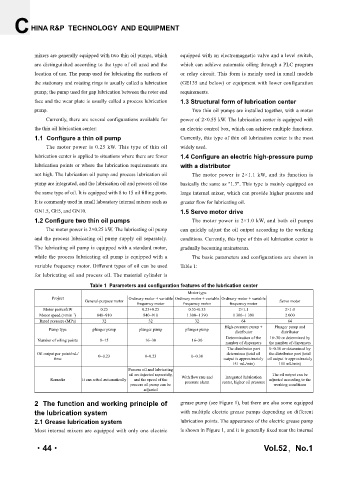
             while the process lubricating oil pump is equipped with a   The basic parameters and configurations are shown in
             variable frequency motor. Different types of oil can be used   Table 1:
             for lubricating oil and process oil. The material cylinder is
                                Table 1  Parameters and configuration features of the lubrication center
                                                                  Motor type
                   Project                   Ordinary motor + variable  Ordinary motor + variable  Ordinary motor + variable
                              General-purpose motor  frequency motor  frequency motor  frequency motor  Servo motor
                Motor power/kW      0.25          0.25+0.25       0.55+0.55        2×1.1           2×1.0
                       .
                          -1
               Motor speed (r min )  840~910      840~910        1 300~1 390     1 300~1 390       2 000
               Rated pressure (MPa)  32             32              32              64              64
                                                                              High-pressure pump +   Plunger pump and
                  Pump type      plunger pump    plunger pump    plunger pump
                                                                                  distributor     distributor
                                                                               Determination of the   16~30 or determined by
              Number of oiling points  8~15        16~30           16~30
                                                                               number of dispensers  the number of dispensers
                                                                               The distributor port   0~0.38 or determined by
              Oil output per point/mL/  0~0.23     0~0.23          0~0.38      determines (total oil   the distributor port (total
                    time                                                      output is approximately  oil output is approximately
                                                                                 151 mL/min)     151 mL/min)
                                             Process oil and lubricating
                                             oil are injected separately,                      The oil output can be
                                                                               Integrated lubrication
                  Remarks    It can refuel automatically  and the speed of the   With flow rate and   center, higher oil pressure  adjusted according to the
                                                                 pressure alarm
                                              process oil pump can be                          working conditions
                                                  adjusted
             2  The function and working principle of          grease pump (see Figure 1), but there are also some equipped
             the lubrication system                            with multiple electric grease pumps depending on different
             2.1 Grease lubrication system                     lubrication points. The appearance of the electric grease pump
             Most internal mixers are equipped with only one electric   is shown in Figure 1, and it is generally fixed near the internal

             ·44·                                                                           Vol.52,No.1

