


Page 84 - 《橡塑技术与装备》英文版2026年1月
P. 84
HINA R&P  TECHNOLOGY  AND EQUIPMENT


             after aging.                                      applications. Typical EPDM aging temperatures include 70°C,
                                                               100°C, 125°C, 150°C, and 175°C. ASTM D 4637 specifies
             2  Results and discussion                         requirements for black EPDM roofing membranes, which
             2.1  Rubber compound processing performance       undergo oven aging at 116°C for 28 days or 7 days, with tensile
                 The Mooney viscosity and vulcanization characteristics   strength after aging not less than 8.3 MPa and elongation at
             of the rubber compound are shown in Table 1.      break not less than 200%.
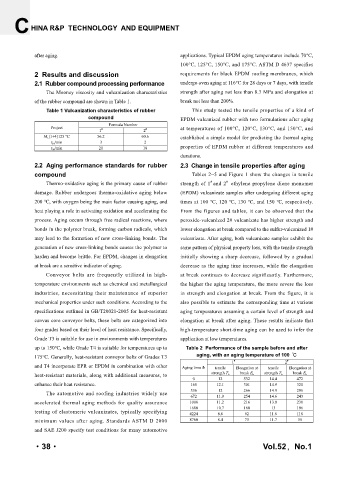
                 Table 1 Vulcanization characteristics of rubber   This study tested the tensile properties of a kind of
                               compound                        EPDM vulcanized rubber with two formulations after aging
                                      Formula Number
                  Project                                      at temperatures of 100°C, 120°C, 130°C, and 150°C, and
                                   1 #            2 #
                M L (1+4)125 ℃    56.2            60.6         established a simple model for predicting the thermal aging
                   t 10 /min       3               2
                   t 90 /min       21             18           properties of EPDM rubber at different temperatures and
                                                               durations.
             2.2  Aging performance standards for rubber       2.3  Change in tensile properties after aging
             compound                                              Tables 2~5 and Figure 1 show the changes in tensile

                 Thermo-oxidative aging is the primary cause of rubber   strength of 1 and 2  ethylene propylene diene monomer
                                                                               #
                                                                         #
             damage. Rubber undergoes thermo-oxidative aging below   (EPDM) vulcanizate samples after undergoing different aging
             200 ℃, with oxygen being the main factor causing aging, and   times at 100 ℃, 120 ℃, 130 ℃, and 150 ℃, respectively.
             heat playing a role in activating oxidation and accelerating the   From the figures and tables, it can be observed that the
             process. Aging occurs through free radical reactions, where   peroxide-vulcanized 2# vulcanizate has higher strength and
             bonds in the polymer break, forming carbon radicals, which   lower elongation at break compared to the sulfur-vulcanized 1#
             may lead to the formation of new cross-linking bonds. The   vulcanizate. After aging, both vulcanizate samples exhibit the
             generation of new cross-linking bonds causes the polymer to   same pattern of physical property loss, with the tensile strength
             harden and become brittle. For EPDM, changes in elongation   initially showing a sharp decrease, followed by a gradual
             at break are a sensitive indicator of aging.      decrease as the aging time increases, while the elongation
                 Conveyor belts are frequently utilized in high-  at break continues to decrease significantly. Furthermore,
             temperature environments such as chemical and metallurgical   the higher the aging temperature, the more severe the loss
             industries, necessitating their maintenance of superior   in strength and elongation at break. From the figure, it is
             mechanical properties under such conditions. According to the   also possible to estimate the corresponding time at various
             specifications outlined in GB/T20021-2005 for heat-resistant   aging temperatures assuming a certain level of strength and
             canvas core conveyor belts, these belts are categorized into   elongation at break after aging. These results indicate that
             four grades based on their level of heat resistance. Specifically,   high-temperature short-time aging can be used to infer the
             Grade T3 is suitable for use in environments with temperatures   application at low temperatures.
             up to 150℃, while Grade T4 is suitable for temperatures up to   Table 2  Performance of the sample before and after
             175℃. Generally, heat-resistant conveyor belts of Grades T3   aging, with an aging temperature of 100 ℃
                                                                                 1 #               2 #
             and T4 incorporate EPR or EPDM in combination with other   Aging time /h  tensile   Elongation at   tensile   Elongation at
             heat-resistant materials, along with additional measures, to   strength T b  break E b  strength T b  break E b
                                                                   0        12       532      14.4     472
             enhance their heat resistance.                        168      12.1     301      14.9     321
                                                                   336      12       266      14.9     296
                 The automotive and roofing industries widely use
                                                                   672      11.9     254      14.6     243
             accelerated thermal aging methods for quality assurance   1008  11.2    216      13.8     230
                                                                  1680      10.7     160      13       196
             testing of elastomeric vulcanizates, typically specifying   4224  8.8   92       11.8     118
             minimum values after aging. Standards ASTM D 2000    8760      8.4      73       11.7     35
             and SAE J200 specify test conditions for many automotive

             ·38·                                                                          Vol.52,No.1

