


Page 43 - 《橡塑技术与装备》英文版2025年12月
P. 43
PROCESS AND EQUIPMENTS


                switch detects the signal, and the electrical system transmits
                a stop command to the hydraulic system. The hydraulic oil
                stops supplying, and the floating cylinder in the hydraulic
                clutch brake moves rightward under the action of the combined
                compression spring, locking the gear shaft. The C-type side
                arm stops moving and remains in a stationary state.


                4  Operating principle of hydraulic system
                and accumulator
                4.1  Operating principle of hydraulic system
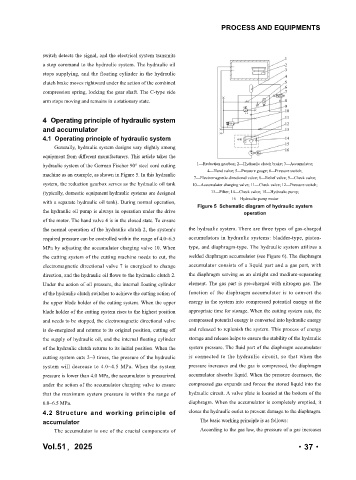
                    Generally, hydraulic system designs vary slightly among
                equipment from different manufacturers. This article takes the
                hydraulic system of the German Fischer 90° steel cord cutting   1—Reduction gearbox; 2—Hydraulic clutch brake; 3—Accumulator;
                                                                        4—Hand valve; 5—Pressure gauge; 6—Pressure switch;
                machine as an example, as shown in Figure 5. In this hydraulic
                                                                    7—Electromagnetic directional valve; 8—Relief valve; 9—Check valve;
                system, the reduction gearbox serves as the hydraulic oil tank   10—Accumulator charging valve; 11—Check valve; 12—Pressure switch;
                (typically, domestic equipment hydraulic systems are designed   13—Filter; 14—Check valve; 15—Hydraulic pump;
                                                                                 16—Hydraulic pump motor
                with a separate hydraulic oil tank). During normal operation,
                                                                     Figure 5  Schematic diagram of hydraulic system
                the hydraulic oil pump is always in operation under the drive        operation
                of the motor. The hand valve 4 is in the closed state. To ensure
                the normal operation of the hydraulic clutch 2, the system's   the hydraulic system. There are three types of gas-charged
                required pressure can be controlled within the range of 4.0~6.5   accumulators in hydraulic systems: bladder-type, piston-
                MPa by adjusting the accumulator charging valve 10. When   type, and diaphragm-type. The hydraulic system utilizes a
                the cutting system of the cutting machine needs to cut, the   welded diaphragm accumulator (see Figure 6). The diaphragm
                electromagnetic directional valve 7 is energized to change   accumulator consists of a liquid part and a gas part, with
                direction, and the hydraulic oil flows to the hydraulic clutch 2.   the diaphragm serving as an airtight and medium-separating
                Under the action of oil pressure, the internal floating cylinder   element. The gas part is pre-charged with nitrogen gas. The
                of the hydraulic clutch switches to achieve the cutting action of   function of the diaphragm accumulator is to convert the
                the upper blade holder of the cutting system. When the upper   energy in the system into compressed potential energy at the
                blade holder of the cutting system rises to the highest position   appropriate time for storage. When the cutting system cuts, the
                and needs to be stopped, the electromagnetic directional valve   compressed potential energy is converted into hydraulic energy
                is de-energized and returns to its original position, cutting off   and released to replenish the system. This process of energy
                the supply of hydraulic oil, and the internal floating cylinder   storage and release helps to ensure the stability of the hydraulic
                of the hydraulic clutch returns to its initial position. When the   system pressure. The fluid part of the diaphragm accumulator
                cutting system cuts 2~3 times, the pressure of the hydraulic   is connected to the hydraulic circuit, so that when the
                system will decrease to 4.0~4.5 MPa. When the system   pressure increases and the gas is compressed, the diaphragm
                pressure is lower than 4.0 MPa, the accumulator is pressurized   accumulator absorbs liquid. When the pressure decreases, the
                under the action of the accumulator charging valve to ensure   compressed gas expands and forces the stored liquid into the
                that the maximum system pressure is within the range of   hydraulic circuit. A valve plate is located at the bottom of the
                6.0~6.5 MPa.                                      diaphragm. When the accumulator is completely emptied, it
                4.2 Structure and working principle of            closes the hydraulic outlet to prevent damage to the diaphragm.
                accumulator                                           The basic working principle is as follows:
                    The accumulator is one of the crucial components of   According to the gas law, the pressure of a gas increases

                Vol.51,2025                                                                            ·37·

