


Page 46 - 《橡塑技术与装备》英文版2025年12月
P. 46
HINA R&P  TECHNOLOGY  AND EQUIPMENT


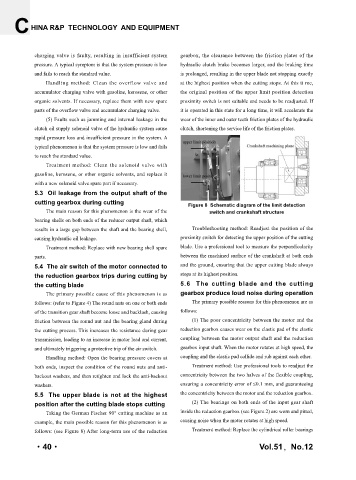
             charging valve is faulty, resulting in insufficient system   gearbox, the clearance between the friction plates of the
             pressure. A typical symptom is that the system pressure is low   hydraulic clutch brake becomes larger, and the braking time
             and fails to reach the standard value.            is prolonged, resulting in the upper blade not stopping exactly
                 Handling method: Clean the overflow valve and   at the highest position when the cutting stops. At this ti me,
             accumulator charging valve with gasoline, kerosene, or other   the original position of the upper limit position detection
             organic solvents. If necessary, replace them with new spare   proximity switch is not suitable and needs to be readjusted. If
             parts of the overflow valve and accumulator charging valve.  it is operated in this state for a long time, it will accelerate the
                 (5) Faults such as jamming and internal leakage in the   wear of the inner and outer teeth friction plates of the hydraulic
             clutch oil supply solenoid valve of the hydraulic system cause   clutch, shortening the service life of the friction plates.
             rapid pressure loss and insufficient pressure in the system. A
             typical phenomenon is that the system pressure is low and fails
             to reach the standard value.
                 Treatment method: Clean the solenoid valve with
             gasoline, kerosene, or other organic solvents, and replace it
             with a new solenoid valve spare part if necessary.
             5.3  Oil leakage from the output shaft of the
             cutting gearbox during cutting                       Figure 8  Schematic diagram of the limit detection
                 The main reason for this phenomenon is the wear of the   switch and crankshaft structure
             bearing shells on both ends of the reducer output shaft, which
             results in a large gap between the shaft and the bearing shell,   Troubleshooting method: Readjust the position of the
             causing hydraulic oil leakage.                    proximity switch for detecting the upper position of the cutting
                 Treatment method: Replace with new bearing shell spare   blade. Use a professional tool to measure the perpendicularity
             parts.                                            between the machined surface of the crankshaft at both ends
             5.4  The air switch of the motor connected to     and the ground, ensuring that the upper cutting blade always
             the reduction gearbox trips during cutting by     stops at its highest position.
             the cutting blade                                 5.6    The  cutting  blade  and  the  cutting
                 The primary possible cause of this phenomenon is as   gearbox produce loud noise during operation
             follows: (refer to Figure 4) The round nuts on one or both ends   The primary possible reasons for this phenomenon are as
             of the transition gear shaft become loose and backlash, causing   follows:
             friction between the round nut and the bearing gland during   (1) The poor concentricity between the motor and the
             the cutting process. This increases the resistance during gear   reduction gearbox causes wear on the elastic pad of the elastic
             transmission, leading to an increase in motor load and current,   coupling between the motor output shaft and the reduction
             and ultimately triggering a protective trip of the air switch.  gearbox input shaft. When the motor rotates at high speed, the
                 Handling method: Open the bearing pressure covers at   coupling and the elastic pad collide and rub against each other.
             both ends, inspect the condition of the round nuts and anti-  Treatment method: Use professional tools to readjust the
             backout washers, and then retighten and lock the anti-backout   concentricity between the two halves of the flexible coupling,
             washers.                                          ensuring a concentricity error of ≤0.1 mm, and guaranteeing
             5.5  The upper blade is not at the highest        the concentricity between the motor and the reduction gearbox.
             position after the cutting blade stops cutting        (2) The bearings on both ends of the input gear shaft
                 Taking the German Fischer 90° cutting machine as an   inside the reduction gearbox (see Figure 2) are worn and pitted,
             example, the main possible reason for this phenomenon is as   causing noise when the motor rotates at high speed.
             follows: (see Figure 8) After long-term use of the reduction   Treatment method: Replace the cylindrical roller bearings

             ·40·                                                                         Vol.51,No.12

