


Page 58 - 《橡塑技术与装备》英文版2026年3期
P. 58
HINA R&P  TECHNOLOGY  AND EQUIPMENT


               c—specific heat capacity of rubber, J/kg℃;        The above calculation is under ideal conditions, and the
               M —Mass (kg), 15 kg for 51-inch semi-steel tires  actual problem to be solved is:
               δ t—For the increased (decreased) temperature (℃), the   Preheat to process temperature externally: upper and
           specific heat capacity of rubber is: instantaneous value 1,700 J/  lower molds at 180℃ (heated by hot plate), pattern blocks
           kg·℃, average value 1,275 J/kg·℃, (calculated based on the   at 180℃ (heated by mold sleeve), maintaining a temperature
           highest value), temperature range: from 0℃ to 210℃, then   difference of ±2℃;
           δ t =210℃.                                            When the internally heated nitrogen enters the capsule, it
               Q x =c . mδ t =1 700×15×210=5 355 000 J=5 355 kJ  needs to quickly reach the process temperature of 210℃ within
               Steam heat loss (excluding pipeline loss):    20 s;
                                 7 599−5 355                     After the secondary vulcanization, the temperature should
                  η=  Φ−Φ x ×100%=          =29.53%
                      Φ            7 599                     be maintained at a process temperature of 210℃ for the first 5
           2.2  Calculation of heat quantity for electric    minutes;
           heating in tire vulcanization                         Hot plate, mold sleeve, internal temperature nitrogen,
               Electric heating is used to simulate the calculated heat
                                                             power required to reach temperature, and temperature control
           for vulcanized tires, and the required heat distribution of the
                                                             module;
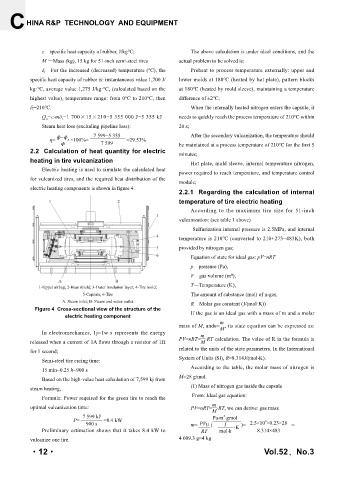
           electric heating components is shown in figure 4.
                                                             2.2.1  Regarding the calculation of internal
                                                             temperature of tire electric heating
                                                                 According to the maximum tire size for 51-inch
                                                             vulcanization: (see table 1 above)
                                                                  Sulfurization internal pressure is 2.5MPa, and internal
                                                             temperature is 210℃ (converted to 210+273=483K), both
                                                             provided by nitrogen gas;
                                                                 Equation of state for ideal gas: pV=nRT
                                                                 p—pressure (Pa),
                                                                 V—gas volume (m³),

              1-Upper airbag; 2-Heat shield; 3-Outer insulation layer; 4-Tire mold;   T—Temperature (K),
                             5-Capsule; 6-Tire                   The amount of substance (mol) of n-gas,
                      A: Steam inlet; B: Steam and water outlet  R—Molar gas constant (J/(mol·K))
             Figure 4  Cross-sectional view of the structure of the
                       electric heating component                If the gas is an ideal gas with a mass of m and a molar
                                                                           m
                                                             mass of M, andn= , its state equation can be expressed as:
                                                                           M
               In electromechanics, 1j=1w·s represents the energy    m
                                                             PV=nRT= . RT calculation. The value of R in the formula is
           released when a current of 1A flows through a resistor of 1Ω   M
           for 1 second;                                     related to the units of the state parameters. In the International
                                                             System of Units (SI), R=8.314J/(mol . K).
               Semi-steel tire curing time:
               15 min=0.25 h=900 s                               According to the table, the molar mass of nitrogen is
               Based on the high-value heat calculation of 7,599 kj from   M=28 g/mol.
           steam heating,                                        (1) Mass of nitrogen gas inside the capsule
               Formula: Power required for the green tire to reach the    From: Ideal gas equation:
                                                                         m
           optimal vulcanization time:                           PV=nRT= . RT, we can derive: gas mass
                                                                         M
                             7 599 kJ                                    Pa . m gmol
                                                                             .
                                                                            3
                          P=        =8.4 kW                                               6
                              900 s                              m= PVμ (    J    )=  2.5×10 ×0.23×28  =
               Preliminary estimation shows that it takes 8.4 kW to   RT   mol . k  . K  8.314×483
           vulcanize one tire.                               4 009.3 g≈4 kg
           ·12·                                                                           Vol.52,No.3

