


Page 56 - 《橡塑技术与装备》英文版2026年3期
P. 56
HINA R&P  TECHNOLOGY  AND EQUIPMENT


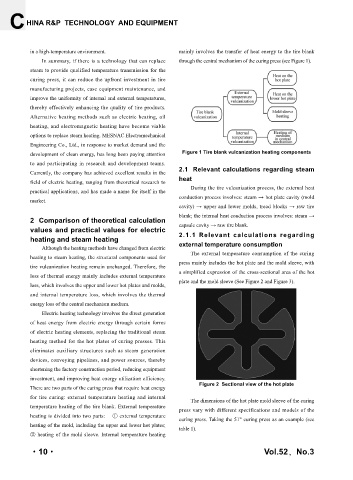
           in a high-temperature environment.                mainly involves the transfer of heat energy to the tire blank
               In summary, if there is a technology that can replace   through the central mechanism of the curing press (see Figure 1).
           steam to provide qualified temperature transmission for the
           curing press, it can reduce the upfront investment in tire
           manufacturing projects, ease equipment maintenance, and
           improve the uniformity of internal and external temperatures,
           thereby effectively enhancing the quality of tire products.
           Alternative heating methods such as electric heating, oil
           heating, and electromagnetic heating have become viable
           options to replace steam heating. MESNAC Electromechanical
           Engineering Co., Ltd., in response to market demand and the
           development of clean energy, has long been paying attention   Figure 1 Tire blank vulcanization heating components
           to and participating in research and development teams.
           Currently, the company has achieved excellent results in the   2.1  Relevant calculations regarding steam
           field of electric heating, ranging from theoretical research to   heat
                                                                 During the tire vulcanization process, the external heat
           practical applications, and has made a name for itself in the
           market.                                           conduction process involves: steam → hot plate cavity (mold
                                                             cavity) → upper and lower molds, tread blocks → raw tire
                                                             blank; the internal heat conduction process involves: steam →
           2  Comparison of theoretical calculation
           values and practical values for electric          capsule cavity → raw tire blank.
           heating and steam heating                         2.1.1  Relevant  calculations  regarding
               Although the heating methods have changed from electric   external temperature consumption
                                                                 The external temperature consumption of the curing
           heating to steam heating, the structural components used for
                                                             press mainly includes the hot plate and the mold sleeve, with
           tire vulcanization heating remain unchanged. Therefore, the
           loss of thermal energy mainly includes external temperature   a simplified expression of the cross-sectional area of the hot
                                                             plate and the mold sleeve (See Figure 2 and Figure 3).
           loss, which involves the upper and lower hot plates and molds,
           and internal temperature loss, which involves the thermal
           energy loss of the central mechanism medium.
               Electric heating technology involves the direct generation
           of heat energy from electric energy through certain forms
           of electric heating elements, replacing the traditional steam
           heating method for the hot plates of curing presses. This
           eliminates auxiliary structures such as steam generation
           devices, conveying pipelines, and power sources, thereby
           shortening the factory construction period, reducing equipment
           investment, and improving heat energy utilization efficiency.
                                                                    Figure 2  Sectional view of the hot plate
           There are two parts of the curing press that require heat energy
           for tire curing: external temperature heating and internal
                                                                 The dimensions of the hot plate mold sleeve of the curing
           temperature heating of the tire blank. External temperature
                                                             press vary with different specifications and models of the
           heating is divided into two parts:   ① external temperature   curing press. Taking the 51" curing press as an example (see
           heating of the mold, including the upper and lower hot plates;
                                                             table 1).
           ② heating of the mold sleeve. Internal temperature heating

           ·10·                                                                           Vol.52,No.3

