


Page 23 - 《橡塑技术与装备》英文版2025年12月
P. 23
THEORY AND RESEARCH


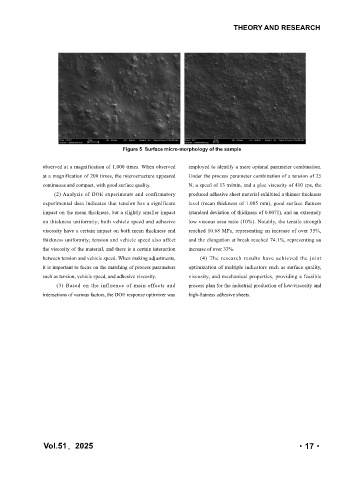
                                           Figure 5  Surface micro-morphology of the sample


                observed at a magnification of 1,000 times. When observed   employed to identify a more optimal parameter combination.
                at a magnification of 200 times, the microstructure appeared   Under the process parameter combination of a tension of 25
                continuous and compact, with good surface quality.  N, a speed of 13 m/min, and a glue viscosity of 410 cps, the
                    (2) Analysis of DOE experiments and confirmatory   produced adhesive sheet material exhibited a thinner thickness
                experimental data indicates that tension has a significant   level (mean thickness of 1.005 mm), good surface flatness
                impact on the mean thickness, but a slightly smaller impact   (standard deviation of thickness of 0.0071), and an extremely
                on thickness uniformity; both vehicle speed and adhesive   low viscous area ratio (10%). Notably, the tensile strength
                viscosity have a certain impact on both mean thickness and   reached 10.68 MPa, representing an increase of over 35%,
                thickness uniformity; tension and vehicle speed also affect   and the elongation at break reached 74.1%, representing an
                the viscosity of the material, and there is a certain interaction   increase of over 33%.
                between tension and vehicle speed. When making adjustments,   (4) The research results have achieved the joint
                it is important to focus on the matching of process parameters   optimization of multiple indicators such as surface quality,
                such as tension, vehicle speed, and adhesive viscosity.  viscosity, and mechanical properties, providing a feasible
                     (3) Based on  the  influence of  main  effects  and   process plan for the industrial production of low-viscosity and
                interactions of various factors, the DOE response optimizer was   high-flatness adhesive sheets.


                Vol.51
                      年,2025
                                                                                                       ·17·
                2025     第   51 卷                                                                      ·17·

