


Page 21 - 《橡塑技术与装备》英文版2025年12月
P. 21
THEORY AND RESEARCH


                (45 N) can cause microcracks in the material due to excessive   (see the slope relationship between glue solution viscosity and
                stretching, as shown in Figure 1(b), affecting the mechanical   mean thickness in the left main effect plot of mean thickness
                strength of the bonded sheet.                     in Figure 2, and the slope relationship between glue solution
                    Vehicle speed has a certain impact on both the mean   viscosity and mean uniformity of thickness in the right main
                thickness and thickness uniformity (see the slope relationship   effect plot of mean uniformity of thickness in Figure 2). Too
                between vehicle speed and mean thickness in the main effect   high a viscosity leads to poor fluidity of the glue solution,
                plot of mean thickness on the left in Figure 2, and the slope   resulting in a significantly thicker material with uneven
                relationship between vehicle speed and mean thickness   thickness. As the viscosity decreases, the fluidity of the glue
                uniformity in the main effect plot of mean thickness uniformity   solution increases, and the uniformity of thickness is improved
                on the right in Figure 2). Too fast a vehicle speed may cause   to some extent.
                the adhesive to cure before it has fully leveled, resulting   2.3 The influence of process parameters on
                in surface defects; too slow a speed may lead to excessive   the viscosity of adhesive sheet materials
                penetration of the adhesive, causing localized thickening of the    In general, the glue solution is the factor that has the
                material. Optimizing the vehicle speed can balance production   greatest impact on the viscosity of materials, especially as
                efficiency and surface quality. When the vehicle speed is low   changes in the viscosity of the glue solution can affect the
                (5 m/min), the adhesive has sufficient time to level, but too   viscosity and reaction activity of the resin, thereby influencing
                low a speed can cause the adhesive to dry and cure locally,   the viscosity of the material. Through data analysis of the DOE
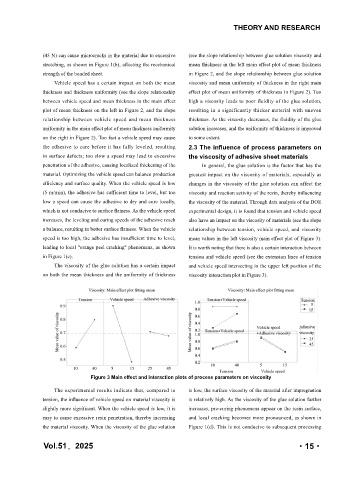
                which is not conducive to surface flatness. As the vehicle speed   experimental design, it is found that tension and vehicle speed
                increases, the leveling and curing speeds of the adhesive reach   also have an impact on the viscosity of materials (see the slope
                a balance, resulting in better surface flatness. When the vehicle   relationship between tension, vehicle speed, and viscosity
                speed is too high, the adhesive has insufficient time to level,   mean values in the left viscosity main effect plot of Figure 3).
                leading to local "orange peel cracking" phenomena, as shown   It is worth noting that there is also a certain interaction between
                in Figure 1(c).                                   tension and vehicle speed (see the extension lines of tension
                    The viscosity of the glue solution has a certain impact   and vehicle speed intersecting in the upper left position of the
                on both the mean thickness and the uniformity of thickness   viscosity interaction plot in Figure 3).


                                Figure 3 Main effect and interaction plots of process parameters on viscosity

                    The experimental results indicate that, compared to   is low, the surface viscosity of the material after impregnation
                tension, the influence of vehicle speed on material viscosity is   is relatively high. As the viscosity of the glue solution further
                slightly more significant. When the vehicle speed is low, it is   increases, pre-curing phenomena appear on the resin surface,
                easy to cause excessive resin penetration, thereby increasing   and local cracking becomes more pronounced, as shown in
                the material viscosity. When the viscosity of the glue solution   Figure 1(d). This is not conducive to subsequent processing

                Vol.51
                      年,2025
                                                                                                       ·15·
                2025     第   51 卷                                                                      ·15·

