


Page 22 - 《橡塑技术与装备》英文版2025年12月
P. 22
HINA R&P  TECHNOLOGY  AND EQUIPMENT


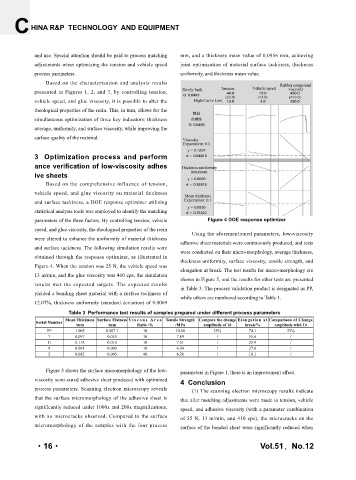
             and use. Special attention should be paid to process matching   mm, and a thickness mean value of 0.0956 mm, achieving
             adjustments when optimizing the tension and vehicle speed   joint optimization of material surface tackiness, thickness
             process parameters.                               uniformity, and thickness mean value.
                 Based on the characterization and analysis results
             presented in Figures 1, 2, and 3, by controlling tension,
             vehicle speed, and glue viscosity, it is possible to alter the
             rheological properties of the resin. This, in turn, allows for the
             simultaneous optimization of three key indicators: thickness
             average, uniformity, and surface viscosity, while improving the
             surface quality of the material.


             3  Optimization process and perform
             ance verification of low-viscosity adhes
             ive sheets
                 Based on the comprehensive influence of tension,
             vehicle speed, and glue viscosity on material thickness
             and surface tackiness, a DOE response optimizer utilizing
             statistical analysis tools was employed to identify the matching
             parameters of the three factors. By controlling tension, vehicle   Figure 4 DOE response optimizer
             speed, and glue viscosity, the rheological properties of the resin
                                                                   Using the aforementioned parameters, low-viscosity
             were altered to enhance the uniformity of material thickness
                                                               adhesive sheet materials were continuously produced, and tests
             and surface tackiness. The following simulation results were
                                                               were conducted on their micro-morphology, average thickness,
             obtained through the response optimizer, as illustrated in
                                                               thickness uniformity, surface viscosity, tensile strength, and
             Figure 4. When the tension was 25 N, the vehicle speed was
                                                               elongation at break. The test results for micro-morphology are
             13 m/min, and the glue viscosity was 410 cps, the simulation
                                                               shown in Figure 5, and the results for other tests are presented
             results met the expected targets. The expected results   in Table 3. The process validation product is designated as PP,
             yielded a bonding sheet material with a surface tackiness of
                                                               while others are numbered according to Table 1.
             12.07%, thickness uniformity (standard deviation) of 0.0069
                         Table 3  Performance test results of samples prepared under different process parameters
                       Mean Thickness  Surface Flatness V iscous Ar ea  Tensile Strength Compare the change Elongation at Comparison of Change
             Serial Number
                           /mm        /mm       Ratio /%     /MPa      amplitude of 1#  break/%  amplitude with 1#
                 PP        1.005     0.007 1      10         10.68         35%         74.1         33%
                  7        0.097      0.010       10          7.89          /          55.6          /
                 11        0.118      0.010       10          7.51          /          23.9          /
                  9        0.091      0.009       10          6.99          /          27.0          /
                  2        0.082      0.005       40          6.28          /          10.1          /


                 Figure 5 shows the surface micromorphology of the low-  parameters in Figure 1, there is an improvement effect.
             viscosity semi-cured adhesive sheet produced with optimized   4  Conclusion
             process parameters. Scanning electron microscopy reveals   (1) The scanning electron microscopy results indicate
             that the surface micromorphology of the adhesive sheet is   that after matching adjustments were made to tension, vehicle
             significantly reduced under 1000x and 200x magnifications,   speed, and adhesive viscosity (with a parameter combination
             with no microcracks observed. Compared to the surface   of 25 N, 13 m/min, and 410 cps), the microcracks on the
             micromorphology of the samples with the four process   surface of the bonded sheet were significantly reduced when


                                                                                               51
                                                                                                        12
             ·16·
             ·16·                                                                          Vol.51,No.12
                                                                                                           期
                                                                                             第
                                                                                                  卷  第

