


Page 19 - 《橡塑技术与装备》英文版2025年12月
P. 19
THEORY AND RESEARCH


                surface flatness, viscosity, tensile strength, and elongation   inspect the tape and the test area to check if any part of the test
                at break of adhesive sheets. Based on this analysis, an   material has peeled off from the test sample. If there is any
                optimization scheme is proposed to achieve the preparation of   peeling, record the area ratio (%) of the peeled-off part. If there
                adhesive sheet materials with low viscosity, high flatness, high   is no peeling, record it as 0.
                tensile strength, and high elongation at break.       Mechanical properties: According to GB/T 1040.2-
                                                                  2006, the tensile strength and elongation at break of the film
                1  Experimental part                              are tested using a universal tensile machine, with 5A standard
                1.1  Main materials and equipment                 specimens selected.
                    The raw materials used mainly include: PTFE film (76   Microscopic morphology: The microscopic surface
                μm), Tianjin Plastics Research Institute; hydrocarbon resin:   roughness of the bonded sheet was observed using a SUPPRA
                polybutadiene, Beijing Yanshan Petrochemical Co., Ltd.;   55VP field emission scanning electron microscope from Zeiss,
                crosslinking agent: dicumyl peroxide (DCP), commercially   Germany.
                available; and additives such as silane coupling agent and co-
                crosslinking agent, commercially available.       2  Analysis of the influence of process
                    The equipment used mainly includes: a precision   parameters on the performance of adhesive
                impregnation machine (self-developed, working width 1000   sheets
                mm, maximum speed 30 m/min, tension (5~50 N)), a high-  2.1  Microscopic morphology analysis
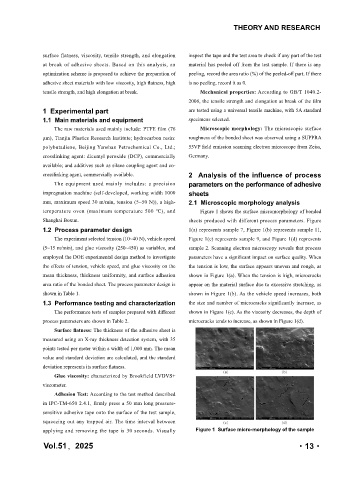
                temperature oven (maximum temperature 500 ℃), and     Figure 1 shows the surface micromorphology of bonded
                Shanghai Boxun.                                   sheets produced with different process parameters. Figure
                1.2  Process parameter design                     1(a) represents sample 7, Figure 1(b) represents sample 11,
                    The experiment selected tension (10~40 N), vehicle speed   Figure 1(c) represents sample 9, and Figure 1(d) represents
                (5~15 m/min), and glue viscosity (250~450) as variables, and   sample 2. Scanning electron microscopy reveals that process
                employed the DOE experimental design method to investigate   parameters have a significant impact on surface quality. When
                the effects of tension, vehicle speed, and glue viscosity on the   the tension is low, the surface appears uneven and rough, as
                mean thickness, thickness uniformity, and surface adhesion   shown in Figure 1(a). When the tension is high, microcracks
                area ratio of the bonded sheet. The process parameter design is   appear on the material surface due to excessive stretching, as
                shown in Table 1.                                 shown in Figure 1(b). As the vehicle speed increases, both
                1.3  Performance testing and characterization     the size and number of microcracks significantly increase, as
                    The performance tests of samples prepared with different   shown in Figure 1(c). As the viscosity decreases, the depth of
                process parameters are shown in Table 2.          microcracks tends to increase, as shown in Figure 1(d).
                    Surface flatness: The thickness of the adhesive sheet is
                measured using an X-ray thickness detection system, with 35
                points tested per meter within a width of 1,000 mm. The mean
                value and standard deviation are calculated, and the standard
                deviation represents its surface flatness.
                    Glue viscosity: characterized by Brookfield LVDVS+
                viscometer.
                    Adhesion Test: According to the test method described
                in IPC-TM-650 2.4.1, firmly press a 50 mm long pressure-
                sensitive adhesive tape onto the surface of the test sample,
                squeezing out any trapped air. The time interval between
                applying and removing the tape is 30 seconds. Visually   Figure 1  Surface micro-morphology of the sample
                Vol.51
                      年,2025
                                                                                                       ·13·
                2025     第   51 卷                                                                      ·13·

