


Page 13 - 《橡塑技术与装备》英文版2025年12月
P. 13
SPECIAL AND COMPREHENSIVE REVIEW


                rigidity. As a result, the straightness and parallelism of the   barrels with large length specifications, and the difficulty in
                machined double holes often exceed the tolerance range,   ensuring the perpendicularity between the plane and the inner
                posing a major challenge in the machining process.  hole. To address these issues, a series of measures need to be
                    Secondly, the machining of double holes requires two   taken for improvement and optimization to enhance processing
                clamping operations, which inherently increases the risk of   accuracy and efficiency, and reduce the rate of rework.
                machining errors due to multiple clamping. Especially when
                the double holes are prone to forming an "eight" shape after   2  Innovative solutions
                grinding, it further increases the difficulty of machining. In   (1) During the machining process of the double holes in
                addition, the perpendicularity between the double holes and   the barrel, due to the issues of low efficiency and difficulty in
                the plane is required to reach 0.03 mm, which is particularly   ensuring quality in the original grinding process, we decided
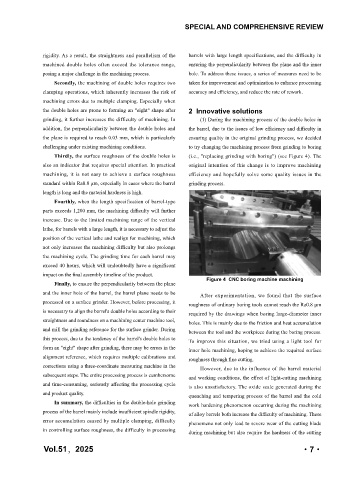
                challenging under existing machining conditions.  to try changing the machining process from grinding to boring
                    Thirdly, the surface roughness of the double holes is   (i.e., "replacing grinding with boring") (see Figure 4). The
                also an indicator that requires special attention. In practical   original intention of this change is to improve machining
                machining, it is not easy to achieve a surface roughness   efficiency and hopefully solve some quality issues in the
                standard within Ra0.8 μm, especially in cases where the barrel   grinding process.
                length is long and the material hardness is high.
                    Fourthly, when the length specification of barrel-type
                parts exceeds 1,200 mm, the machining difficulty will further
                increase. Due to the limited machining range of the vertical
                lathe, for barrels with a large length, it is necessary to adjust the
                position of the vertical lathe and realign for machining, which
                not only increases the machining difficulty but also prolongs
                the machining cycle. The grinding time for each barrel may
                exceed 40 hours, which will undoubtedly have a significant
                impact on the final assembly timeline of the product.
                                                                        Figure 4  CNC boring machine machining
                    Finally, to ensure the perpendicularity between the plane
                and the inner hole of the barrel, the barrel plane needs to be   After experimentation, we found that the surface
                processed on a surface grinder. However, before processing, it   roughness of ordinary boring tools cannot reach the Ra0.8 μm
                is necessary to align the barrel's double holes according to their   required by the drawings when boring large-diameter inner
                straightness and roundness on a machining center machine tool,   holes. This is mainly due to the friction and heat accumulation
                and mill the grinding reference for the surface grinder. During   between the tool and the workpiece during the boring process.
                this process, due to the tendency of the barrel's double holes to   To improve this situation, we tried using a light tool for
                form an "eight" shape after grinding, there may be errors in the
                                                                  inner hole machining, hoping to achieve the required surface
                alignment reference, which requires multiple calibrations and   roughness through fine cutting.
                corrections using a three-coordinate measuring machine in the   However, due to the influence of the barrel material
                subsequent steps. The entire processing process is cumbersome   and working conditions, the effect of light-cutting machining
                and time-consuming, seriously affecting the processing cycle   is also unsatisfactory. The oxide scale generated during the
                and product quality.                              quenching and tempering process of the barrel and the cold
                    In summary, the difficulties in the double-hole grinding   work hardening phenomenon occurring during the machining
                process of the barrel mainly include insufficient spindle rigidity,   of alloy barrels both increase the difficulty of machining. These
                error accumulation caused by multiple clamping, difficulty   phenomena not only lead to severe wear of the cutting blade
                in controlling surface roughness, the difficulty in processing   during machining but also require the hardness of the cutting

                Vol.51,2025                                                                              ·7·

