


Page 9 - 《橡塑技术与装备》英文版2025年12月
P. 9
SPECIAL AND COMPREHENSIVE REVIEW


                increases, and the PET depolymerization effect is
                significant. However, if the temperature is set too high,
                the reflux of ethylene glycol increases significantly,
                energy consumption increases, and the color of the product
                gradually deepens. However, after calculation, the yield
                of the reaction product PHET does not show a significant
                increase.Therefore, the optimal reaction temperature is
                controlled at 200 ℃.


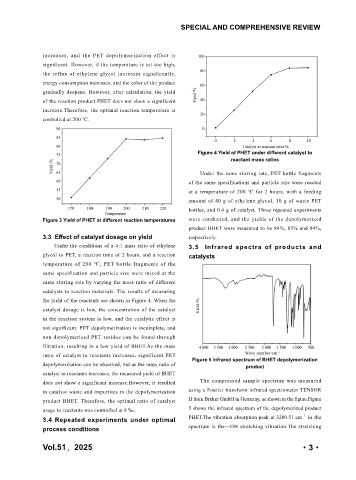
                                                                     Figure 4 Yield of PHET under different catalyst to
                                                                                reactant mass ratios
                                                                      Under the same stirring rate, PET bottle fragments
                                                                  of the same specifications and particle size were reacted
                                                                  at a temperature of 200 ℃ for 2 hours, with a feeding
                                                                  amount of 40 g of ethylene glycol, 10 g of waste PET
                                                                  bottles, and 0.4 g of catalyst. Three repeated experiments
                Figure 3 Yield of PHET at different reaction temperatures  were conducted, and the yields of the depolymerized
                                                                  product BHET were measured to be 84%, 83% and 84%,
                3.3  Effect of catalyst dosage on yield           respectively.
                    Under the conditions of a 4:1 mass ratio of ethylene   3.5  Infrared spectra of products and
                glycol to PET, a reaction time of 2 hours, and a reaction   catalysts
                temperature  of  200  ℃,  PET  bottle  fragments  of  the
                same specification and particle size were mixed at the
                same stirring rate by varying the mass ratio of different
                catalysts to reaction materials. The results of measuring
                the yield of the reactants are shown in Figure 4. When the
                catalyst dosage is low, the concentration of the catalyst
                in the reaction system is low, and the catalytic effect is
                not significant. PET depolymerization is incomplete, and
                non depolymerized PET residue can be found through
                filtration, resulting in a low yield of BHET.As the mass
                ratio of catalyst to reactants increases, significant PET
                                                                   Figure 5 Infrared spectrum of BHET depolymerization
                depolymerization can be observed, but as the mass ratio of            product
                catalyst to reactants increases, the measured yield of BHET
                does not show a significant increase.However, it resulted   The compressed sample spectrum was measured
                in catalyst waste and impurities in the depolymerization   using a Fourier transform infrared spectrometer TENSOR
                product BHET. Therefore, the optimal ratio of catalyst   II from Bruker GmbH in Germany, as shown in the figure.Figure
                usage to reactants was controlled at 8 ‰.         5 shows the infrared spectrum of the depolymerized product
                                                                                                         -1
                3.4 Repeated experiments under optimal            PHET.The vibration absorption peak at 3280.51 cm  in the
                process conditions                                spectrum is the—OH stretching vibration.The stretching


                Vol.51,2025                                                                             ·3·

