


Page 76 - 《橡塑技术与装备》英文版2026年1月
P. 76
HINA R&P  TECHNOLOGY  AND EQUIPMENT


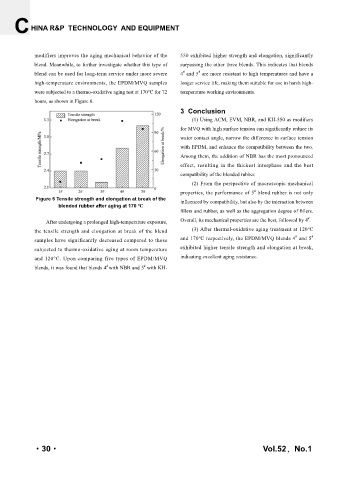
             modifiers improves the aging mechanical behavior of the   550 exhibited higher strength and elongation, significantly
             blend. Meanwhile, to further investigate whether this type of   surpassing the other three blends. This indicates that blends
                                                                #
                                                                     #
             blend can be used for long-term service under more severe   4  and 5  are more resistant to high temperatures and have a
             high-temperature environments, the EPDM/MVQ samples   longer service life, making them suitable for use in harsh high-
             were subjected to a thermo-oxidative aging test at 170℃ for 72   temperature working environments.
             hours, as shown in Figure 6.
                                                               3  Conclusion
                                                                   (1) Using ACM, EVM, NBR, and KH-550 as modifiers
                                                               for MVQ with high surface tension can significantly reduce its
                                                               water contact angle, narrow the difference in surface tension
                                                               with EPDM, and enhance the compatibility between the two.
                                                               Among them, the addition of NBR has the most pronounced
                                                               effect, resulting in the thickest interphase and the best
                                                               compatibility of the blended rubber.
                                                                   (2) From the perspective of macroscopic mechanical
                                                                                         #
                                                               properties, the performance of 5  blend rubber is not only
             Figure 6 Tensile strength and elongation at break of the   influenced by compatibility, but also by the interaction between
                     blended rubber after aging at 170 ℃
                                                               fillers and rubber, as well as the aggregation degree of fillers.

                 After undergoing a prolonged high-temperature exposure,   Overall, its mechanical properties are the best, followed by 4 . #
             the tensile strength and elongation at break of the blend   (3) After thermal-oxidative aging treatment at 120℃
                                                                                                            #
                                                                                                       #
             samples have significantly decreased compared to those   and 170℃ respectively, the EPDM/MVQ blends 4  and 5
             subjected to thermo-oxidative aging at room temperature   exhibited higher tensile strength and elongation at break,
             and 120°C. Upon comparing five types of EPDM/MVQ   indicating excellent aging resistance.
                                      #
                                                   #
             blends, it was found that blends 4 with NBR and 5  with KH-


             ·30·                                                                          Vol.52,No.1

