


Page 75 - 《橡塑技术与装备》英文版2026年1月
P. 75
MATERIALS AND FORMULATIONS


                                                                                                  #
                                                                  increase in hardness was the greatest for 5  and the smallest
                                                                      #
                                                                  for 4 . Furthermore, the elongation at break change rate of
                                                                  the modified EPDM/MVQ blends was lower than that of the
                                                                  unmodified blends. That is, considering both change rates, the
                                                                                 #
                                                                  aging resistance of 4  blend was the best, and compared to the
                                                                  unmodified 1  blend, the aging resistance of 2 ~5  blends was
                                                                                                      #
                                                                            #
                                                                                                    #
                                                                  slightly better.


                    Figure 3 Wear resistance of EPDM/MVQ blends


                2.5 Aging resistance


                    The samples of EPDM/MVQ blend were subjected to
                thermo-oxidative aging at 120 ℃ for 72 hours. During this
                process, the crosslinking density of the blend increased, and its
                hardness and modulus at a fixed extension increased compared
                                                                    Figure 4 Change rate of hardness and elongation at
                to before aging. The mechanical property data of the aged   break of the blend before and after aging
                blend is shown in Table 4. The decrease in tensile strength
                and elongation at break of blends 1#, 3#, and 4# is due to
                the excessive crosslinking density, which leads to an uneven
                crosslinking network. Under external forces, the number of
                stress concentration points increases, making them prone to
                fracture. The increase in tensile strength of blends 2# and 5#
                indicates that their vulcanization degree increased during the
                thermo-oxidative aging process, and the crosslinking network
                structure is relatively uniform. Overall, under the same aging
                conditions, the tensile strength and elongation at break of the
                modified blend are higher than those of the unmodified one.
                  Table 4  Mechanical properties of aged EPDM/MVQ
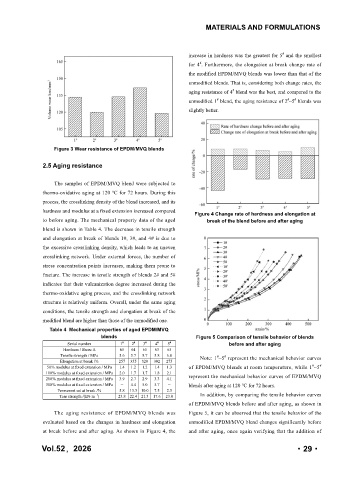
                                    blends                          Figure 5 Comparison of tensile behavior of blends
                        Serial number     1 #  2 #  3 #  4 #  5 #               before and after aging
                       Hardness / Shore A  65  64  65  63  65
                      Tensile strength / MPa  5.6  5.7   5.7   5.8   6.8   Note: 1 ~5  represent the mechanical behavior curves
                                                                            #
                                                                              #
                      Elongation at break /%  257  355  328  302  275
                                                                                                            #
                                                                                                               #
                 50% modulus at fixed extension / MPa  1.4   1.2   1.2   1.4   1.3   of EPDM/MVQ blends at room temperature, while 1 ~5
                 100% modulus at fixed extension / MPa  2.0   1.7   1.7   1.8   2.1   represent the mechanical behavior curves of EPDM/MVQ
                 200% modulus at fixed extension / MPa  3.9   2.7   2.9   3.3   4.1
                 300% modulus at fixed extension / MPa  -  4.4   5.0   5.7   -  blends after aging at 120 ℃ for 72 hours.
                     Permanent set at break /%  5.8  13.3  10.0   7.5   2.5
                      Tear strength /(kN·m )  23.8  22.4  21.3  17.6  23.0   In addition, by comparing the tensile behavior curves
                                  -1
                                                                  of EPDM/MVQ blends before and after aging, as shown in
                    The  aging  resistance  of  EPDM/MVQ  blends  was   Figure 5, it can be observed that the tensile behavior of the
                evaluated based on the changes in hardness and elongation   unmodified EPDM/MVQ blend changes significantly before
                at break before and after aging. As shown in Figure 4, the   and after aging, once again verifying that the addition of

               Vol.52,2026                                                                            ·29·

