


Page 49 - 《橡塑技术与装备》英文版2026年1月
P. 49
SPECIAL AND COMPREHENSIVE REVIEW


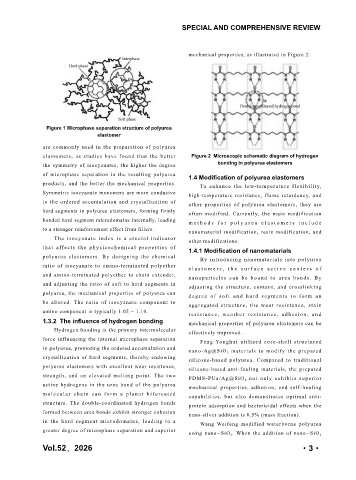
                                                                  mechanical properties, as illustrated in Figure 2.


                 Figure 1 Microphase separation structure of polyurea
                                   elastomer

                are commonly used in the preparation of polyurea
                elastomers, as studies have found that the better   Figure 2  Microscopic schematic diagram of hydrogen
                the symmetry of isocyanates, the higher the degree          bonding in polyurea elastomers
                of microphase separation in the resulting polyurea   1.4 Modification of polyurea elastomers
                products, and the  better  the  mechanical  properties.
                                                                      To enhance  the  low-temperature  flexibility,
                Symmetric  isocyanate  monomers  are  more  conducive   high-temperature resistance, flame retardancy, and
                to the ordered accumulation and crystallization of   other properties of polyurea elastomers, they are
                hard segments in polyurea elastomers, forming firmly
                                                                  often modified. Currently, the main modification
                bonded hard segment microdomains internally, leading   methods for polyurea elastomers include
                to a stronger reinforcement effect from fillers.  nanomaterial modification, resin modification, and
                    The isocyanate index is a crucial indicator
                                                                  other modifications.
                t ha t  a ffe c t s t h e  p h y si c o c he m i c a l  pr o p e rt i e s o f   1.4.1 Modification of nanomaterials
                polyurea elastomers. By designing the chemical
                                                                      By introducing nanomaterials into polyurea
                ratio of isocyanate to amino-terminated polyether   elastomers, the surface active centers of
                and amino-terminated polyether to chain extender,
                                                                  n a no pa r t i c l e s c a n be  b ou nd  t o  u re a  b ond s.  B y
                and adjusting the ratio of soft to hard segments in
                                                                  adjusting the structure, content, and crosslinking
                polyurea, the mechanical properties of polyurea can   degree of soft and hard segments to form an
                be altered.  The ratio of isocyanate component to
                                                                  aggregated structure, the wear resistance, stain
                amino component is typically 1.05 ~ 1.10.
                                                                  resistance, weather resistance, adhesion, and
                1.3.2  The influence of hydrogen bonding          mechanical properties of polyurea elastomers can be
                    Hydrogen bonding is the primary intermolecular   effectively improved.
                force influencing the internal microphase separation   Feng  Yonghui utilized core-shell structured
                in polyurea, promoting the ordered accumulation and
                                                                  nano-Ag@SiO 2  materials to modify the prepared
                crystallization of hard segments, thereby endowing   silicone-based  polyurea.  Compared to traditional
                polyurea elastomers with excellent wear resistance,   silicone-based  anti-fouling  materials,  the  prepared
                strength, and an elevated melting point.  The two
                                                                  PDMS-PUa/Ag@SiO 2  not only exhibits superior
                active hydrogens in the urea bond of the polyurea   mechanical properties, adhesion, and self-healing
                mole cul ar cha in c an form a planar bi furc ated   capabilities, but also demonstrates optimal anti-
                structure.  The double-coordinated hydrogen bonds
                                                                  protein adsorption and bactericidal effects when the
                formed between urea bonds exhibit stronger cohesion   nano-silver addition is 0.5% (mass fraction).
                in the hard segment microdomains, leading to a        Wang  Weifeng  modified waterborne  polyurea
                greater degree of microphase separation and superior
                                                                  using nano-SiO 2 .  When the addition of nano-SiO 2
                Vol.52,2026                                                                             ·3·

